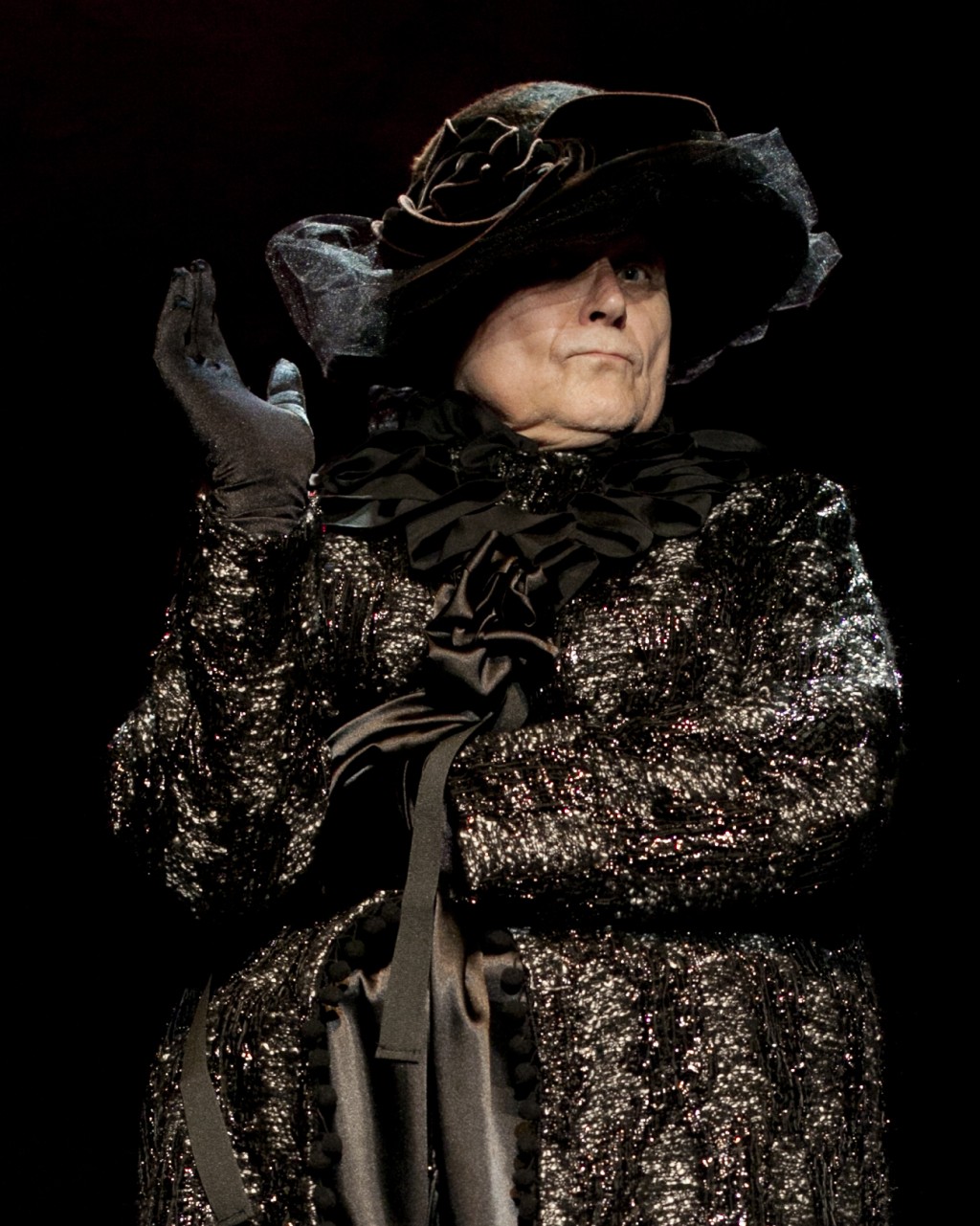

About the performance
Niko Goršič is an idiosyncratic figure in the public life of Slovenia and ex-Yugoslavia. Actor, director, dance and art critic, passionate theater and exhibition visitor, film lover, reader, satirist …
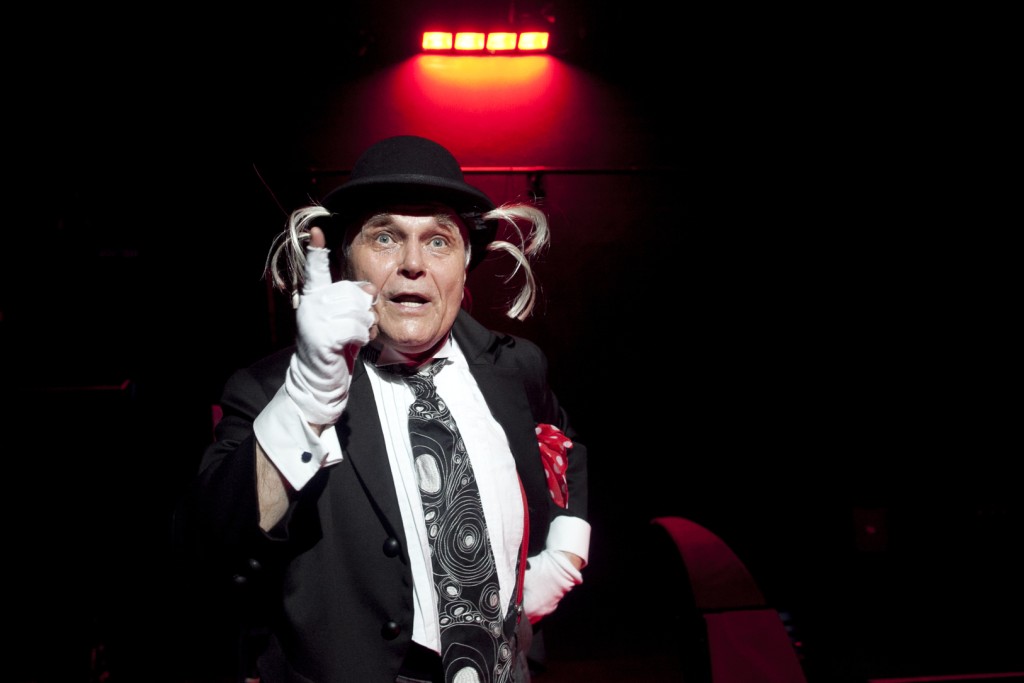
He is a part of the urban legends known by salons of the 18th century. His interest precedes artistic and social events. He is a passionate analyst who offers suggestions, definitions, categorizations and constant changes to the cultural scene. And it is of most importance that he has dedicated all of his time to the promotion of (post)modernism in all his forms. Innovativeness is for Goršič conditio sine qua non of artistic creativity and avant-garde the mother of all practices. Therefore it is not unusual that stage as the topos of avant-garde is his main fortress. From the very beginning of Mini teater, Niko Goršič has been its actor, friend and critic. Chair(s) are his personal view of the past (Yugo)Slovenian theater and an intimate retrospective of a grand career which was never preceded by narcissism, acknowledgement or café anecdotes, but is deeply integrated into the consciousness of the meaning of merged, joined (first Slovenian Youth Theater, then Slovenian theater and art in general).
Inspired by Ionesco’s Chairs, he integrates its cleverness into the dialect of modern Slovenian theater - already analyzed by one of Goršič’s predecessors Taras Kermauner. An older man and woman live in an isolated house surrounded by the sea. To kill boredom they repeat the same stories and moves. The man has a message he would like to send to humanity. So he calls out for a Speaker who would know how to carry the message to the people better than him. He gathers the most important people of his time. He predicts a chair for each and every one of them. But no one will sit in them, for these people do not exist – they are but phantoms. Goršič’s effort not to forget “the historical truth” of the greatness of Youth Theater and its world mission is enormous and at certain moments, tragi-comical. Niko Goršič the actor, will/has kindly invited all the directors, CEO’s and actors he has ever worked with throughout history to hear his message. At the end, Ionesco’s Old Man and Woman throw themselves out the window, while the Speaker remains on his own, to turn to the invisible crowd. The Message will not be delivered.
The potential of the story reminds us of the metaphysics of Kafka and Borghes, the laughter of old people, Fellini’s heroes, the unbeatable pathos of Mozart … It is a comical and tragic side of human existence that begins to lose it sense. When an old man is a child, the nostalgia for childhood and the lost happiness rise up in him, and he moves from play to regression. The actor behaves as a child, and the child and the clown are creatures that are constantly surprised by all that goes on in the world.
Ivica Buljan, dramaturge
About the actor / director
Niko Goršič – Nick Upper (directorial pseudonym)
Actor, director, performer and writer
Niko Goršič, also known as director Nick Upper, graduated as an actor at the Academy for Theatre, Film, Radio and Television Ljubljana in 1970. He spent his fruitful career contributing to the international reputation of SMG - the Slovensko Mladinsko Gledališče theatre. Over the years, he has toured around more than 300 festivals in 28 countries. He was one of the frontmen of theatre postmodernism in the former Yugoslavia, appearing in 150 roles and directing over 20 productions. In the seventies he appeared as a performer in visual arts-related projects and innovated acting with puzzle technique. In 1999 he established Global Theatre, dedicated to research of classical theatre and performance theatre interaction, whose productions featured at over 70 festivals. Until present day, he has collaborated with 35 theatre institutions. He currently dedicates most of his time to the shaping of Balkan's cultural parallel (he is directing in Slovenia, Montenegro, Macedonia and Croatia). He received 28 prizes and awards (mostly in theatre). He also studied art history and music. He had been active as an editor, journalist, dance and visual arts critic. He founded several awards, with the Zlata ptica (Golden Bird) award for young artists still being awarded annually after 35 years.
From critiques
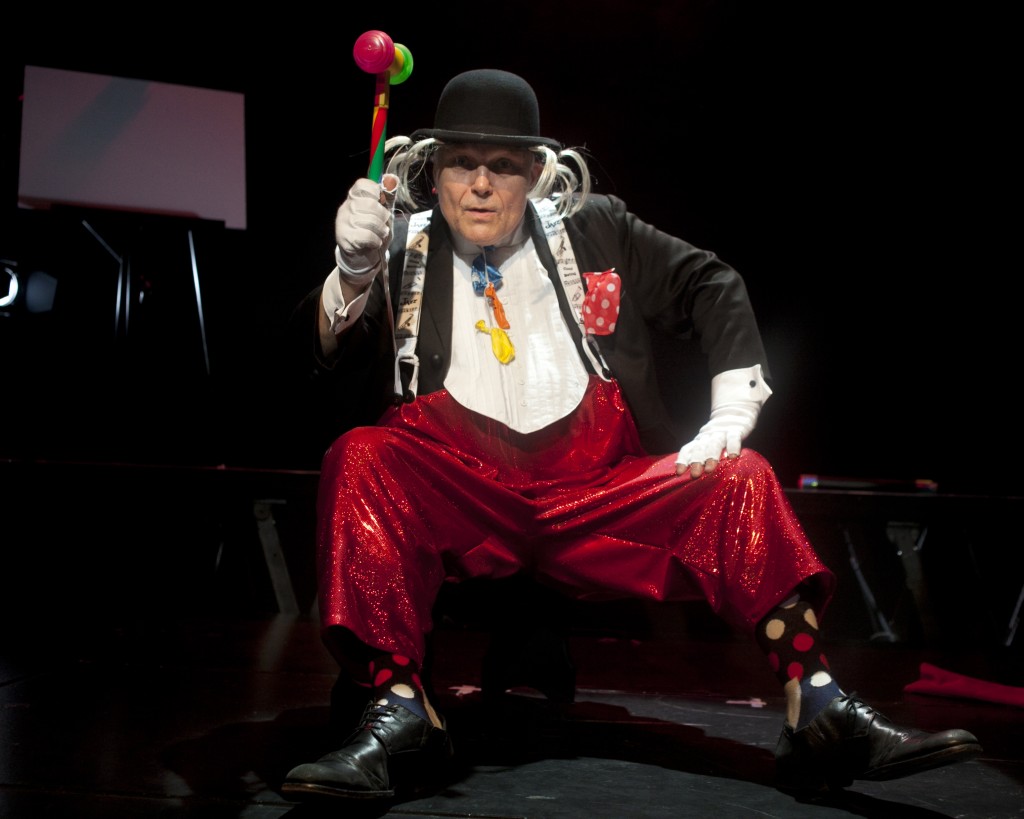
“In the new post-drama production of Mini teater that derives from Ionesco’s Chairs and moderates them into meaningfully shaded Chair(s), chairs that fill the acting space of the original Ionesco’s play are not in abundance. To be exact there is only one chair on stage with footstool next to it; chair for invited “giants” (for eminent guests physically unattended escorted by Ionesco’s Elders) for those that have in the past perhaps sat on some chair and footstool for the host, the actor and director in one person with two names /…/ Nevertheless Goršič, once fully occupied actor and nowadays such viewer exploits the staging opportunity to look into the past of his own creativity and theater in previous and actual country. As a long term actor of the Slovenian youth theater focuses on this exact institution – there he for example starred in known Freyer’s adaptation of Chairs (Prihajajo, 1992) and strolls with a certain dose of self-irony through the personal selection of important, spicy and similar moments in its history. Therefore it is not completely inadequate to ask why this performance with such content involvement of a certain theater was created under a different producer. However Goršič’s requiem that follows the structure of Ionesco’s text after beginning’s strong attachment to it (actor forst appears in a role of old woman) with many transformations continues more and more with his author’s approaches. In a certain moment he stages a clown fest which in Goršič’s terms supports itself to Ionesco’s closeness of diversities, his fear from death and the feeling of the mortality of human life and inserts to the performance something sad. But the emphasis is not at last on comedian entity; and if Goršič’s intent is to entertain he has to be given the acknowledgement that in certain derivations he is truly successful.” Ana Perne, Stoli, stolčki, nato še pručka (Chair, chairs and then footstool); Dnevnik, 11.01.2013
»Uncontrolled gathering of Ionesco’s invisible guests is this time very locally marked: at the scene phantom silhouettes of former and actual directors and actors are gathering; principals, theorists and critics are moving in from all Yugoslavia, largely and without a pause, theater scene is vast and the host welcomes them in heat enthusiasm and also principal consideration from which sooner or later a raw comment is forced on surface. /…/ Chair(s) that are not merely in content but also a visual-multimedia conglomerate (Uršula Berlot, son:DA) are ironic but an intimate commemoration for the actor in his own interpretation that is surrounded by an undiplomatic and brutal open-hearted view of home theater scene. They are a symbolic divorce and at the same time a new wedding. «Zala Dobovšek, Izživeti in izživljati se (To live and to take pleasure in), Delo, 12.01.2013
»If Ionesco’s Chairs are an attempt to beat death Goršič’s Chair(s) in which he offers a subjective view on history of Slovenian youth theater and its meaning for Slovenian culture space, the confrontation with Slovenian theatrical scene, and with himself in which the laughter from the audience is not drawn from large shoes or clown hat but from the detils from anecdotes in which star to premiere audience’s very well-known names of Slovenian there giants. So, in which case do Chair(s) represent and overachievement of an internal event meant for theatrical art? Maybe in the fact that the Chair(s) are not just a story of Slovenian youth theater, of Jovanović, Taufer, Sever … They are in theatrical micro cosmos trapped story of complex, human relations, story of power, desire, loneliness, desire for self-realization, the awareness of own insignificance, self-denial and persistence. And when the shining confetti falls, when with playful persistence under a clown hat the audience is provoked to laughter, through the cracks of comic enters a thought about the transience of the moment. When large things suddenly appear small and small things for a moment appear large. And personally told show continues. A show that is not only a story of Niko Goršič and of Slovenian Youth Theater. It is also a story about questions we all ask ourselves, that rise when finality and eternity coexists. It is a settlement with life.« Saška Rakef RA Slovenija 1, 09.01.2013
Before the premiere, Niko Goršič talked to Nika Arhar about his performance for the web portal of Slovenian National Television: Goršič starts the performance as an Old lady following Ionesco’s text, shortened here to use only the Old Lady's words. Afterwards, he relocates to the role of the Old Man who quickly turns into a Clown, Court Jester and, through the Actor's plurality of aspects, probably even someone else. Chair(s) are a performance based upon the drama text of Eugѐne Ionesco. In it the dramaturge Goršič completely followed Ionesco, keeping the main theme lines but changing and adapting the context to modern times, by connecting it to the Slovenian youth theater in which he has worked for over 40 years and to the story of his own career – building the performance in the post-modern style of a stylish conglomerate.
»The ending in Ionesco’s Chairs is a complex staging task and many creators have a problem with it. I have chosen a co-actor that most beautifully concludes Ionesco, as well as acting as my requiem. I did not want to make up the Speaker – there have been too many. I think that with Mozart as the Speaker at the human’s death, with his requiem replacing the stuttering Speaker, I have created a great homage for Ionesco. Today’s attitude towards absurd, mine at least, is no longer tragic. We live this absurd; we are aware of it and sometimes make fun of. It is a completely different aspect of the absurd and the world is different as well.« More from the interview Chairs and Char(s): Šaljiva učna ura "človeka s pručko" oz. sodobni komentar na Ionesca za MMC, January 10th 2013
Chair(s) also on the portal of Slovenian Theater Personal overlook into the past of (Yugo)Slovenian theater, Sigledal, January 8th 2013.
Citations from the essay "strength and weakness of the language" by Taras Kermauner
“For today’s wider Slovenian public, Eugene Ionesco is a classic … A lot of ink has been spilt around Ionesco (and Beckett, Sartre, Camus etc) … With Ionescu Stage 57 gained legitimation of the avant-garde, non-conformist, critical and ideologically problematic theater. But besides the resistance of the official cultural politics that it encountered (Ionesco can therefore be seen as a grandfather or emblem in the name of whom the restructure of the Slovene after war drama was fought), Ionesco is a radical critic of the idealism and logo centrism … As the rotten meat of Novo Mesto’s metaphysical tradition falls off piece by piece, we are faced with the brutal reality of some fake world. World based upon a lie, fiction, nothing … But what is what it is? What is it like? To this Ionesco - even more eminently philosophical dramatic in CHAIR(S) - gives a single answer: "The only solid reality is human’s desire, recognition, dreaming … subconscious-conscious yet in majority subconscious practice of desires, constructions of the world. The goal is only one – to be God. Meaning: to know of the Truth, to be in a position (role), when everyone depends on you, when you are the absolute Father, identical to the Idea (Logos). That is the desire of every single one of us, it is the law under which we are constructed, it is the old man’s life tendency … of a human’s self-deceit, reality, desires, dreams, imagination, of the Message that people are waiting for but resists to come (the parallel to the Beckett’s text Waiting for Godot).”
Festivals
4th NETA festival (International Festival Of New European Theatre Action) in Vratsa, Bolgaria: May 2013
11th International Theatre Festival Actor of Europe in Resen Macedonia; July 2013
Awards
Award for best performance of the 4th NETA festival (International Festival Of New European Theatre Action) in Vratsa, Bolgaria; May 2013
Award for the most creative project at the 11th International Theatre Festival Actor of Europe in Resen Macedonia; July 2013